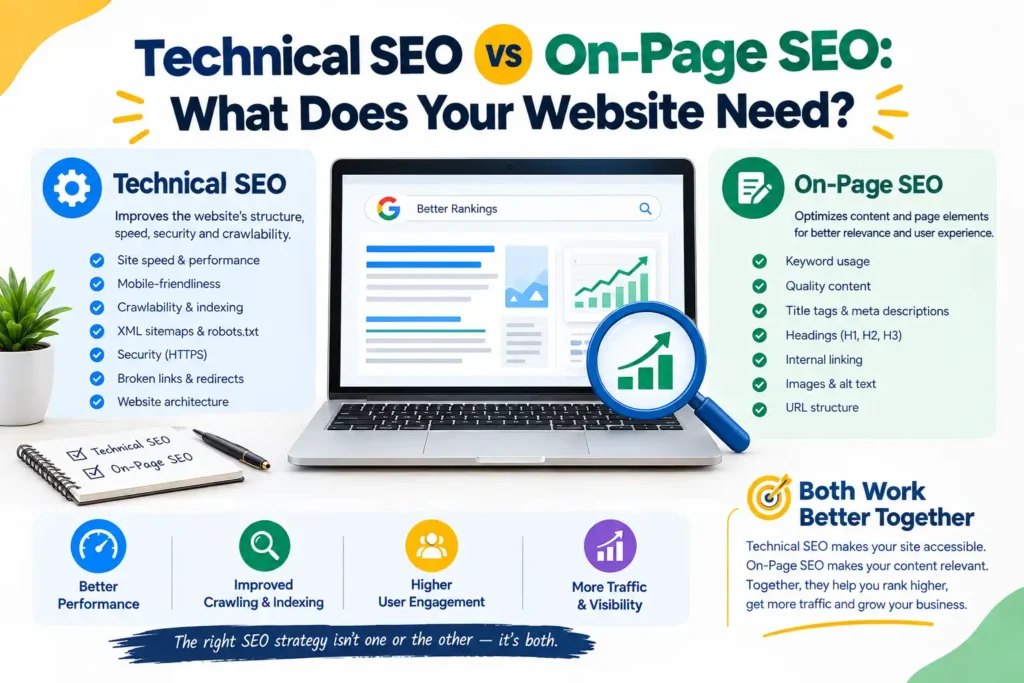
Technical SEO and On-Page SEO are two essential parts of a successful search engine optimization strategy. While both aim to improve a website’s visibility in search results, they focus on different areas. Technical SEO improves the website’s structure, speed, security, and crawlability, whereas On-Page SEO focuses on content, keywords, headings, and user experience. Understanding the differences between technical SEO vs on-page SEO helps website owners identify what their website needs to perform better in search engines.
Overview of Technical SEO vs On-Page SEO
Technical SEO
Technical SEO is all about working with the technical part of a site to enable the search engine to crawl and index it. It covers the speed of the website, its mobile-friendliness, web structure, security, broken links, XML sitemaps, and crawlability. A technically qualified site is more pleasant to visitors and easier to locate in search engines because important pages will be available readily.
On-Page SEO
On-Page SEO deals with optimizing content and web page characteristics. It additionally incorporates employing relevant keywords, development of useful information, title tags, headings, URLs, images, and Meta descriptions optimization. On-page SEO is good since information enables search engines to know what the page include. At the same time, it enable the content to be useful, clear, and interesting to readers.
Technical SEO vs On-Page SEO: Key Differences
Main Focus
Technical SEO enhances the technical base of the website, whereas On-Page SEO enhances content and the page features that are visible. The areas of focus in technical SEO are indexing, crawling, speed, security, and site structure. On-Page SEO dwells on such factors as keywords, headings, content quality, titles, descriptions, and images, and other aspects that convey the content of a page.
Website Performance
The performance of websites is also important to major SEO services Pakistan. It helps increase loading speed, mobile-friendliness, and technical performance. On-Page SEO is not all about performance but can also enhance the ease of comprehension and engagement of a visitor with the content. Both can be helpful in streamlining the website and making it more helpful.
Content Optimization
The optimization of the content of websites is primarily due to On-Page SEO. It includes the natural usage of appropriate keywords, creation of useful data, structuring data with headings, and writing descriptive titles and Meta descriptions. Technical SEO helps in this process by making search engines have access to the optimized pages of the site in a proper manner, which can be crawled and indexed.
Search Engine Crawling
There are direct implications of technical SEO on how a website is crawled and indexed by the search engines. The presence of good internal linking, XML sitemaps, robots.txt files, redirects, and clear site structure assists search engines in crawling and finding pages. On-Page SEO is more concerned with assisting search engines to comprehend the topic and relevance of each particular page.
User Experience
Technical SEO enhances user experience; it is faster, mobile-friendly, secure, and has few technical problems. On-Page SEO enhances readability by having organized and comprehensible content that is simple to read and understand. With both being taken care of, visitors will be able to use the site without any undue frustration.
Optimization Process
Technical SEO normally entails taking into account web environments, code, design, performance, and crawling issues. On-Page SEO consists of optimizing the content and HTML of each of the pages. Technical improvement is generally a problem that is site-wide. Improvement of on-page is possible on a page-by-page basis, category by category, content section by content section.
Long-Term SEO Foundation
Technical SEO offers a good base on which search engines can positively access and process a site. On-Page SEO helps individual pages stay useful and appreciable to specific searches. The two areas should be maintained because good content may not work in the case of technical problems. This does not allow search engines access to the content or may not interpret the content in the new way.
Signs Your Website Needs Technical SEO vs On-Page SEO
Technical SEO might be required on your site in case of slow page loading, mobile difficulties, key pages not being indexed, broken links, and difficulty in crawling the site by search engines. Such technical issues as redirect problems or duplicate pages, security issues, and an unclear layout of the site can also appear.
On-Page SEO can be necessary when your content is not relevant to the search intent, pages are not ranked for the search keywords, titles and headings are unclear, or the information on the page is shallow, old-fashioned, or poorly formatted. Looking at both of them can help you identify whether you are experiencing a problem with the functionality of your websites, with the quality of your content, or with both.
Can Technical SEO and On-Page SEO Work Together?
On-Page SEO and Technical SEO collaborate and are valuable components of a whole SEO strategy. Technical SEO is important because it makes sure that your website can be crawled, accessed, and indexed by search engines with ease. On-Page SEO will help search engines identify how the pages are used, the subject, and the applicability of those pages.
Hence, there are certain technical problems with which search engines would not be able to view the page as they should. Likewise, a technically powerful site can fail to draw applicable organic traffic in a case where the content is incomprehensible or not helpful. Combining the two would be a stronger foundation for both the search presence and visitor experience.
FAQs: Commonly Asked Questions
1. What is the difference between technical SEO and on-page SEO?
Technical SEO improves the infrastructure of websites. On-page optimization optimizes websites, pages, content, keywords, headings, titles, as well as the user experience.
2. Is technical SEO more important than on-page SEO?
Neither is universally more important; technical SEO supports accessibility. On-page SEO improves relevance, usefulness, and search intent alignment.
3. What does a technical SEO audit include?
A technical SEO audit is about the analysis of crawling, indexing, site speed, mobile usability, redirects, broken links, architecture, security, and other technical factors.
Build a Website That Search Engines and Customers Can Find
Your website shouldn’t simply exist online; it should help your business get discovered. Whether you are dealing with technical SEO issues, underperforming pages, or inconsistent organic traffic, a focused SEO strategy can identify what needs attention. Get in touch with Hamdan Ibrahim to discuss your website, uncover opportunities, and turn search visibility into meaningful business growth.